
Arrow Maze-Tap Away
HONG KONG XINGXICasual
4.81.09K Reviews
- Version
- 1.1.6
- Installs
- 1.00M
- Age Rating
- Everyone
Screenshots
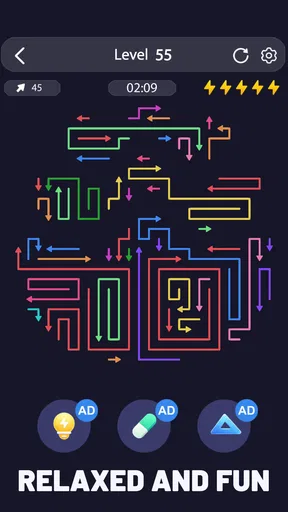
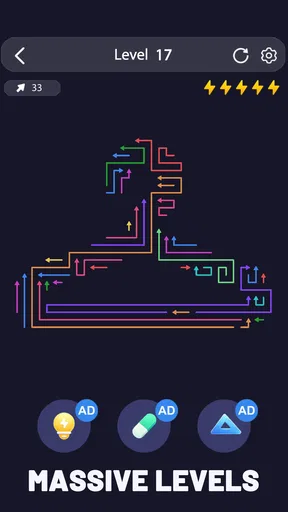
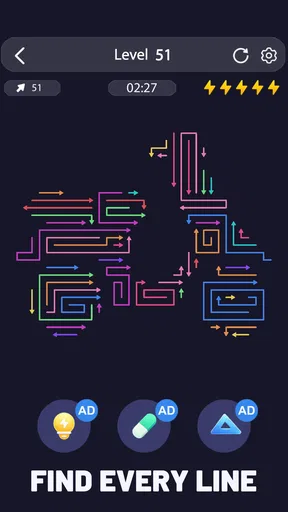
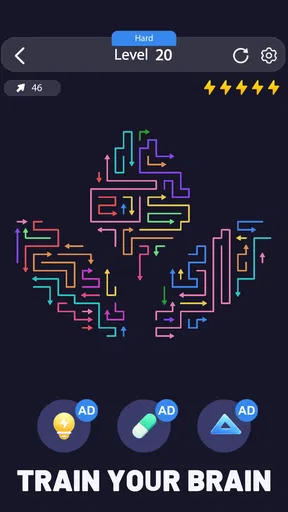
Our Review of Arrow Maze-Tap Away
 Analysis by Appyee
I approached Arrow Maze-Tap Away as the kind of casual game you open when you want a focused break rather than a large adventure, a competitive match, or a complicated strategy session. Its central idea is easy to understand: clear arrows from a maze by moving them in the right direction. The presentation is minimalist, but the decisions become more demanding as the layout asks you to think about order, space, and blocked paths.
That simplicity is the main reason I found it appealing. There is no need to learn a long rulebook before starting, and the game fits naturally into short pauses during the day. At the same time, it is not merely a reflex exercise. The useful question is not only which arrow I can move now, but which move will leave the board in a better condition for the next few turns. For anyone choosing between a small puzzle game and the usual endless stream of quick arcade distractions, that difference matters.
How I Judge Whether This Puzzle Fits
My first decision criterion is the kind of concentration a game demands. Arrow Maze-Tap Away works best when I want a quiet mental task with a clear objective. The board gives me something concrete to inspect, and each successful move reduces the remaining problem. That makes it more satisfying than tapping through an activity that depends mainly on speed or repetition.
The second criterion is accessibility. This is a free casual game from HONG KONG XINGXI, with an Everyone content rating, so it is positioned as an easy title to pick up for a broad audience. It supports devices running Android 8.0 or later, and its current version is 1.1.6. Those details make it a practical option for people who do not want a demanding hardware requirement or a game aimed at a narrow age group.
I also look at whether the basic interaction remains understandable after the first few rounds. Here, the arrow itself communicates the intended direction, while the maze supplies the challenge. That combination keeps the learning curve gentle. I did not need to memorize special abilities, character statistics, or a complicated interface before I could concentrate on solving the board.
For me, the most important test is whether the game rewards planning without making every mistake feel unfair. A good puzzle should make me recognize why a move failed. Arrow Maze-Tap Away has the right foundation for that kind of learning because the board is visible and the objective is direct. I can review the remaining arrows, identify the obstruction, and change my order instead of blaming a hidden rule.
The appeal of a board that explains itself
The minimalist design is more than a visual choice. It keeps attention on the geometry of the maze and the direction of each arrow. In a busier puzzle game, decorative effects, characters, or several types of resources can distract from the actual problem. Here, the reduced presentation makes the board feel like a small visual exercise.
That makes it particularly suitable for a short routine. I can play while waiting for an appointment, during a coffee break, or when I want to switch away from work without committing to a long session. The game does not ask me to remember a story or return at a precise time. Its value is concentrated in the puzzle directly in front of me.
There is also a useful mental shift between the opening and the middle of a board. At first, I tend to look for an obvious arrow that has a clear route. Later, I have to stop treating every arrow as an independent object. One move can change the available space for several others, so the board becomes a sequence problem. That is where the title earns its place as a brain-training style casual game rather than a simple tapping toy.
Where it wins over familiar casual choices
Compared with a conventional match-three game, this title puts less emphasis on spotting combinations and more on anticipating consequences. Match-three games are often better when I want constant movement, colorful feedback, or a stronger sense of chain reactions. Arrow Maze-Tap Away is the better fit when I want to slow down and inspect a position before acting.
It also differs from endless runners and quick arcade games. Those alternatives usually reward reaction time, rhythm, or repeated attempts at a fast sequence. This maze format is more deliberate. I am not trying to keep a character alive through an accelerating course; I am trying to remove the board without creating a dead end for myself.
Compared with word puzzles, the advantage is that language ability is not central to the experience. The arrows and pathways make the central task immediately readable. Someone who enjoys visual logic but does not want clues, vocabulary, or trivia may find this more comfortable. On the other hand, players who love discovering words or building answers from letters may find the visual structure too restrained.
Against larger strategy games, the trade-off is equally clear. Arrow Maze-Tap Away has a much lower entry cost because there are fewer systems to manage. I do not need to study a technology tree, assemble a team, or follow a campaign. The price of that convenience is reduced depth outside the board itself. If I want a world, character progression, or long-term strategic planning, another category will offer more.
Small habits that make the puzzles easier
The most useful habit I developed was to scan for arrows with an unobstructed route before touching anything. That first pass prevents me from making a move simply because it looks available. An open path is not always the most valuable path, but it often reveals which parts of the maze are already close to resolution.
A second habit is to work backward from the most constrained arrow. If one arrow has very little room to move, I treat it as a priority and ask what must disappear before it can be cleared. This is more reliable than following the most visually prominent arrow. The board rewards attention to bottlenecks, and that insight remains useful when the layout becomes less obvious.
I also try to preserve flexibility. Clearing several arrows from one area may feel productive, but it can leave the remaining pieces awkwardly arranged. When two moves seem equally safe, I prefer the one that keeps more routes open. This is a subtle trade-off that makes the game more interesting than its single-action controls suggest.
Finally, I avoid rushing after a successful move. The board may look simpler, but the new arrangement can change the best order. Taking a moment to rescan the whole maze is usually more effective than continuing with the original plan. That pause is especially helpful on a phone, where a quick tap can be made before I have really understood the position.
What everyday use feels like
Imagine having ten quiet minutes before leaving for work. I can open the game, solve a few boards, and stop without feeling that I have abandoned a larger task. If I get interrupted, the experience is still easy to return to because the objective is self-contained: inspect the arrows and find the clearing order.
It also works as a transition between activities. After a long stretch of reading or screen-heavy work, a visual puzzle gives my attention a different shape without demanding the emotional investment of a story game. I found that the best sessions were not necessarily the longest ones. A handful of carefully considered puzzles can feel more refreshing than an extended run through repetitive arcade rounds.
For families, the Everyone rating makes the game easier to consider as a shared casual option. The rules are simple enough to explain by showing the board, and discussing possible moves can become part of the fun. Still, I would not assume that every child will enjoy the same level of restraint. Players who expect constant animation or immediate rewards may need time to appreciate the slower logic.
Where the minimalist approach creates friction
The same simplicity that helps the game stay accessible can also limit its appeal. If I am looking for a strong sense of progression, a narrative reason to continue, or a broad collection of activities, the arrow-maze format may feel narrow. The pleasure comes from solving the current arrangement, not from developing a character or exploring a changing world.
There is also a risk of mental repetition. Once I understand the basic method, some boards may feel like variations on the same visual question. That is not necessarily a flaw in a short-break puzzle, but it matters if I want one game to occupy my attention for long sessions every day. A broader puzzle collection may be a better choice for someone who needs several distinct mechanics.
Another limitation is that the game favors patience over excitement. I would not choose it when I want music-driven energy, competition, or a rapid challenge against another person. The title is most comfortable in the space between a brain teaser and a calming time filler. Players who prefer immediate action may interpret the careful pace as a lack of variety.
When another category is the better choice
If your main goal is improving typing, vocabulary, or general knowledge, a word game or quiz will serve that purpose more directly. If you want to train rapid reactions, an arcade game is likely to provide stronger feedback. If you want a long-term hobby with social interaction, a multiplayer title may justify the extra complexity.
I would also steer away from this game if you dislike puzzles where one early decision can make the rest of the board feel awkward. The visible layout helps explain the challenge, but it also means the responsibility sits with the player. Some people enjoy recovering from a poor move; others prefer systems that automatically keep the action flowing.
For players who regularly use larger logic games, the decision depends on convenience. A deep Sudoku app, a nonogram collection, or a full puzzle platform may offer more variety and more demanding problem types. Arrow Maze-Tap Away wins when I want a narrower task that I can understand immediately, not when I want the richest possible puzzle library.
What switching to it involves
The cost of switching is low in terms of learning. I do not have to replace a familiar control scheme with several gestures or remember a large set of rules. The main adjustment is psychological: I need to accept that the right move may be less obvious than the fastest move. Once I start evaluating routes and future space, the interaction becomes natural.
It is also free to try, which makes it easier to use as a secondary game rather than a permanent replacement for a favorite. With over a million installs and an average rating of 4.8 from around 85 thousand ratings, it has clearly attracted substantial interest. Those figures do not determine whether its quiet puzzle style matches me, but they do make it a title worth testing when this category appeals to me.
The developer’s version number, 1.1.6, indicates the build I would look for when checking the game on a compatible device. I would still approach installation with ordinary care, especially on an older phone, and give myself a few sessions before deciding whether the minimalist presentation holds my attention. A first impression can be misleading if I only play the easiest boards.
One practical advantage is that the game does not require me to schedule a large block of time. I can use it as a small mental reset, then put it away. That makes switching easier for people who are tired of games that turn every visit into a commitment. The trade-off is that it may not become a central daily pastime unless the basic arrow-clearing loop is exactly the type of repetition they enjoy.
My recommendation for different players
I recommend Arrow Maze-Tap Away to anyone who likes visual logic, short sessions, and puzzles that reward planning rather than reflexes. It is especially suitable if you want a free casual game with an Everyone rating, a straightforward premise, and enough decision-making to make a few minutes feel purposeful.
I would recommend it less strongly to players who need story, competition, social features, or a wide range of mechanics. It is not trying to be a complete entertainment package. Its strength is the focused board, and that focus becomes a weakness if you expect constant novelty.
My best advice is to judge it by the quality of your attention, not by the amount of content you expect from a larger game. If you enjoy examining a maze, identifying the most restricted route, and changing your plan after each move, the minimalist design gives those choices room to matter. If you prefer tapping quickly and watching the game create excitement for you, a more active casual alternative will probably feel better.
After using it as a decision-based break, I see the game as a compact puzzle tool rather than a title that needs to replace everything else on a phone. Its real strength is the balance between immediate rules and thoughtful move order. That makes it easy to start, but not completely mindless. For the right player, that is enough reason to keep it installed; for everyone else, the same narrow focus is a clear signal to choose a different kind of casual game.
Verdict
Strengths of Arrow Maze-Tap Away
- Simple one-touch controls are easy to learn.
- Short levels make it suitable for quick gaming sessions.
- Colorful visuals keep the minimalist design appealing.
- Puzzle difficulty gradually increases without overwhelming new players.
- Works well for players who enjoy relaxing, casual challenges.
Limitations of Arrow Maze-Tap Away
- Later puzzles can feel repetitive due to similar mechanics.
- Mistakes may require repeating portions of a level.
- Limited gameplay variety may reduce long-term appeal.
- Small visual details can be difficult to distinguish on some screens.
- Progress may feel slow for players seeking fast-paced action.
Similar Picks in This Category
View All
My Talking Angela
Outfit7 Limited4.2

My Talking Tom
Outfit7 Limited4.3

Pou
Zakeh4.2

My Talking Tom 2: Pet Game
Outfit7 Limited4.3

Candy Crush Saga
King4.6

Bridge Race
Supersonic Studios LTD4.1
Frequently Asked Questions
What is Arrow Maze-Tap Away and how is it played?
Arrow Maze-Tap Away is a puzzle game focused on clearing a board of arrow-shaped pieces. You tap or select arrows in the correct direction so they can move away without being blocked by other pieces. As levels progress, the layouts become more crowded and require careful planning, visual attention, and an understanding of the order in which each arrow must be removed.
Is Arrow Maze-Tap Away suitable for beginners and casual players?
Yes. The game is designed to be easy to understand because its main interaction is based on tapping arrows and solving compact maze-like arrangements. Early stages generally work as a tutorial, helping you learn how blocked paths and movement directions function. Later puzzles demand more thought, but the gradual difficulty makes it accessible for casual players as well as fans of logic and brain-training games.
Does Arrow Maze-Tap Away require an internet connection?
The basic puzzle experience may be playable without a permanent internet connection, which makes it convenient for short sessions while traveling or when mobile data is unavailable. However, certain features can depend on connectivity, including advertisements, online rewards, updates, analytics, or promotional content. It is best to open the game once while connected and check which modes remain available when your device is offline.
Are there advertisements or in-app purchases in Arrow Maze-Tap Away?
Like many free-to-download puzzle games, Arrow Maze-Tap Away may include advertising and optional purchases. Advertisements can appear between levels or after requesting extra assistance, while purchases may be offered for removing ads, obtaining hints, or unlocking other conveniences. Before downloading, review the current store listing and payment information, since pricing, offer availability, and the frequency of ads can change with updates.
What should I know about permissions, privacy, and device compatibility?
Before installing Arrow Maze-Tap Away, check its Google Play or App Store listing for the latest compatibility requirements, download size, and privacy disclosures. Puzzle games normally need access to basic device and network functions for operation, advertising, crash reporting, or analytics, but the exact permissions vary by version and platform. Downloading from the official store is the safest way to receive authentic updates and avoid modified files.
Play our best games!


